What new Really Does: Four Steps Behind Every JavaScript Constructor
Constructor functions, the four steps new performs, how it links objects to prototypes, and the gotchas, with a hand-built new and real output
Here's a constructor function, called without new:
function Person(name) {
  this.name = name;
}

const result = Person("Oops");   // no new!
console.log(result);
console.log(globalThis.name);
undefined
Oops
The function returned undefined, and name ended up on globalThis, the global object. No new object was created. The function ran like any ordinary function, with this pointing at the global scope (in a normal, non-strict file), so this.name = name quietly set a global variable.
Without new, nothing gives the function a fresh object to fill in. That silent leak only happens in a plain script; run the same code as an ES module and it throws instead, as the strict-mode example below shows. This post covers what new does, how constructor functions use it, and how it connects each object to a prototype, including a hand-built version of new tested against the real one. Every output is real, from Node.js 24.22.
What the new keyword does
new Person("Asha") performs four steps, in order:
- It creates a new, empty object.
- It links that object to
Person.prototype, so the object can use methods stored there. - It calls
Personwiththisset to the new object. - It returns that object (unless the constructor returns a different object, covered below).
Steps 2 and 3 are where the interesting parts are, and the sections below take them one at a time.
Constructor functions
A constructor function is an ordinary function written to be called with new. By convention its name starts with a capital letter, so readers know to use new:
function Person(name, age) {
  this.name = name;
  this.age = age;
}

const asha = new Person("Asha", 24);
const ravi = new Person("Ravi", 22);
console.log(asha);
console.log(ravi);
Person { name: 'Asha', age: 24 }
Person { name: 'Ravi', age: 22 }
Each new Person(...) call ran the function once, with this as a fresh object, and handed that object back. Two calls gave two separate objects. The Person at the front of the printout is the name of the constructor that made each one.
Inside the constructor, this is the same "who is calling" idea from Look Left of the Dot. new is one more way JavaScript decides what this is.
Forgetting new doesn't always leak onto the global object. In strict mode, which modules and classes use automatically, it fails loudly instead:
"use strict";
function Person(name) {
  this.name = name;
}
Person("Oops");   // no new!
TypeError: Cannot set properties of undefined (setting 'name')
In a plain strict-mode call, this is undefined, so this.name = name has nothing to write to.
Creating an object, step by step
The best way to see what new does is to rebuild it. Here's myNew: Object.create covers steps 1 and 2, apply covers step 3, and the last line is step 4. It's tested against the real new:
function Person(name) {
  this.name = name;
}
Person.prototype.greet = function () {
  return `Hi, I'm ${this.name}`;
};

function myNew(Constructor, ...args) {
  const obj = Object.create(Constructor.prototype);   // 1 + 2: empty object, linked to the prototype
  const result = Constructor.apply(obj, args);        // 3: run the constructor with this = obj
  const returnedAnObject = typeof result === "object" && result !== null;
  return returnedAnObject || typeof result === "function" ? result : obj;   // 4: hand back the object
}

const real = new Person("Asha");
const mine = myNew(Person, "Asha");
console.log("real:", real, "| mine:", mine);
console.log("same prototype:", Object.getPrototypeOf(real) === Object.getPrototypeOf(mine));
console.log("mine instanceof Person:", mine instanceof Person);
console.log("mine.greet():", mine.greet());
real: Person { name: 'Asha' } | mine: Person { name: 'Asha' }
same prototype: true
mine instanceof Person: true
mine.greet(): Hi, I'm Asha
The result has the same shape, the same prototype, passes instanceof, and can use the prototype method greet. The last line of myNew handles one edge case: if the constructor itself returns an object, that object wins. I show that in the gotchas below.

One honest limit: myNew is a teaching version, not a replacement. It can't build instances of a class, because calling a class without new throws, and it ignores details like new.target.
How new links prototypes
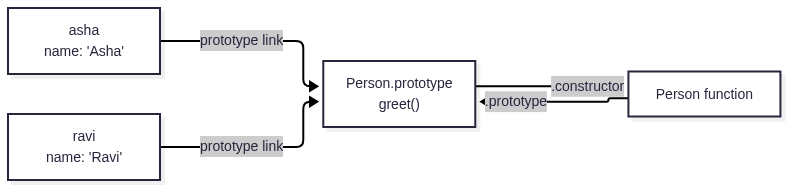
Step 2 is the one that surprises people. Every ordinary function declared with function has a prototype property (arrow functions, async functions and method shorthand don't get one): an object that new uses as the prototype of everything it creates. Put a method on it, and every instance can use it:
function Person(name) {
  this.name = name;
}
Person.prototype.greet = function () {
  return `Hi, I'm ${this.name}`;
};

const asha = new Person("Asha");
const ravi = new Person("Ravi");

console.log(Object.getPrototypeOf(asha) === Person.prototype);
console.log(Object.hasOwn(asha, "name"), Object.hasOwn(asha, "greet"));
console.log(asha.greet === ravi.greet);
console.log(asha.greet(), "/", ravi.greet());
true
true false
true
Hi, I'm Asha / Hi, I'm Ravi
Four lines, four facts:
- The instance's prototype is
Person.prototype(true). nameis the instance's own property, butgreetisn't (true false).greetlives on the prototype.- Still,
asha.greet === ravi.greetistrue: both objects found the same function. - Each call used its own
this, so each greeted with its own name.
When you write asha.greet(), JavaScript looks on asha first. It doesn't find greet there, so it follows the link to Person.prototype and finds it. That trail of links is the prototype chain.
Compare that with defining the method inside the constructor:
function Dog(name) {
  this.name = name;
  this.bark = function () {      // a new function for every dog
    return "Woof";
  };
}

console.log(new Dog("Bruno").bark === new Dog("Rex").bark);
false
Each new Dog(...) created a brand-new bark function, so the two dogs hold two different copies (false). On the prototype, there's one function shared by all. That's why methods usually go on the prototype.
Instances made from constructors
An instance is an object made by new from a given constructor. JavaScript can answer "what made this?" in a few ways:
function Person(name) {
  this.name = name;
}
const asha = new Person("Asha");

console.log(asha instanceof Person);
console.log(asha instanceof Object);
console.log(asha.constructor === Person);
console.log(Object.hasOwn(asha, "constructor"));
console.log(Person.prototype.constructor === Person);
true
true
true
false
true
asha instanceof Personistrue:instanceofchecks whetherPerson.prototypeappears in the object's prototype chain.asha instanceof Objectis alsotrue. The chain continues up toObject.prototype, which nearly every object inherits from.asha.constructor === Personistrue, yetObject.hasOwn(asha, "constructor")isfalse.ashahas noconstructorof its own; it found one onPerson.prototype, which points back at the function that made it. The last line shows that link directly.
Gotchas
A constructor can return something else. Normally it doesn't return anything, and new hands back the object it built. But if the constructor returns an object, new uses that instead:
function ReturnsObject() {
  this.a = 1;
  return { b: 2 };       // an object replaces the new one
}
function ReturnsPrimitive() {
  this.a = 1;
  return 42;             // a primitive is ignored
}

console.log(new ReturnsObject());
console.log(new ReturnsPrimitive());
{ b: 2 }
ReturnsPrimitive { a: 1 }
The first call returned { b: 2 }, and the object with a: 1 was thrown away. The second returned 42, a primitive, which new ignores. That's why constructors normally don't use return at all.
Arrow functions can't be constructors.
const Person = (name) => {
  this.name = name;
};
new Person("Asha");
TypeError: Person is not a constructor
An arrow function has no this of its own, and no prototype for new to link to, so new has nothing to work with. Use a regular function, or a class, for constructors.
new and classes
class syntax runs the same machinery, with tidier clothes:
class Person {
  constructor(name) {
    this.name = name;
  }
  greet() {
    return `Hi, I'm ${this.name}`;
  }
}

console.log(typeof Person);
console.log(Person.prototype.constructor === Person);
const asha = new Person("Asha");
console.log(Object.hasOwn(asha, "greet"), Object.getPrototypeOf(asha) === Person.prototype);
Person("Asha");
function
true
false true
TypeError: Class constructor Person cannot be invoked without 'new'
typeof Person is "function", Person.prototype.constructor points back at it, and greet, written inside the class, ended up on the prototype (false true: not an own property, and the prototype link is intact). That's exactly what the hand-written version did. The one difference is the last line: a class refuses to run without new, instead of leaking onto globalThis.
I covered classes in One Blueprint, Many Objects. In new code, prefer class: it's harder to misuse. Constructor functions are still worth knowing because you'll meet them in older code, and because they show what class does underneath. And as in the string polyfills post, don't add methods to built-in prototypes like Array.prototype in your own application code.
The takeaway: new creates an empty object, links it to the constructor's prototype, runs the constructor with this set to that object, and returns it. Methods on the prototype are shared by every instance; methods created inside the constructor are copied for each one. This post stopped before inheritance between constructors, which builds on exactly these prototype links.
Create two objects with new from the same constructor and compare Object.getPrototypeOf(a) === Object.getPrototypeOf(b). What do you expect, and why?
Comments
Join the discussionNo comments yet. Be the first to comment.