Cookies Aren't Auth: Sessions vs JWT vs Cookies Explained
What cookies, sessions, and JWTs actually are, stateful vs stateless auth in Express 5.3.0, and how to pick the right one
People compare sessions vs JWT vs cookies as if all three were competing authentication systems. They are not.
A cookie is not an authentication strategy — it is a browser storage and transport mechanism, like an envelope. Sessions and JWTs are the two authentication strategies you can put inside that envelope. You can carry a session ID in a cookie, and you can carry a JWT in a cookie too (or in an Authorization: Bearer header).
Once you separate the envelope from the letter, the real architectural choice becomes clear: stateful sessions vs stateless JWTs. Every output below comes from a real run on Node.js 24.22.1, Express 5.3.0, and jsonwebtoken 9.0.3.
What cookies are (the envelope)
A cookie is a small key-value string that a server asks the browser to save using the Set-Cookie HTTP response header:
Set-Cookie: sid=9f3a...; HttpOnly; Secure; SameSite=Lax; Path=/
On every later request to the same domain, the browser attaches that cookie automatically in the Cookie request header — no frontend JavaScript required.
Three cookie flags matter in practice:
HttpOnly— hides the cookie fromdocument.cookie, so JavaScript (including injected XSS scripts) cannot read it.Secure— sends the cookie only over HTTPS connections.SameSite=Lax(orStrict) — limits sending the cookie on cross-site requests, reducing CSRF risk.
Because a cookie is only a carrier, it does not decide how the server verifies the user. That job belongs to either a session or a JWT.
What sessions are (stateful authentication)
In session-based authentication, the server stores the user's login state (in Redis, a database, or memory during local dev) under a random, unguessable session ID.
- User logs in with email and password.
- Server creates a session record (
sid → { user: "Asha", role: "member" }) in its session store. - Server sends only the opaque session ID to the browser in an
HttpOnlycookie. - On every later request, the browser sends the cookie, and the server looks up the session ID in its store.
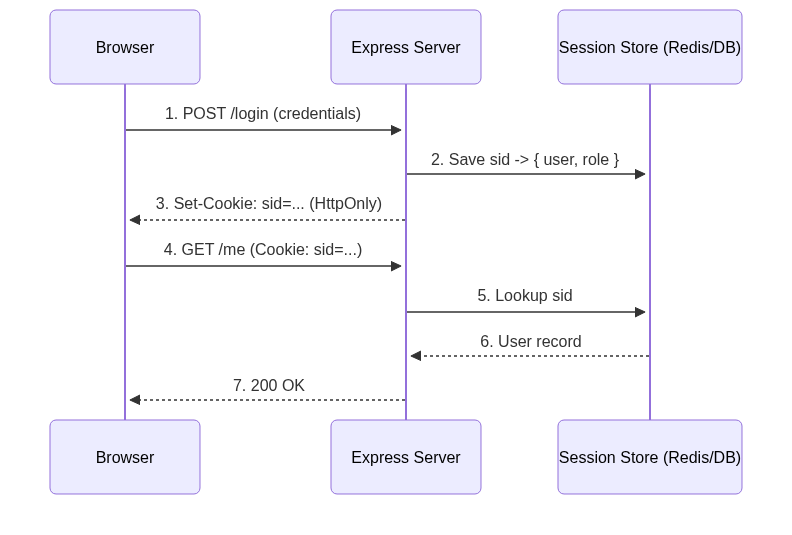
Notice why this is called stateful: the server remembers who is currently logged in. Delete that row from the session store, and the user is logged out immediately everywhere.
What JWT tokens are (stateless authentication)
In JWT (JSON Web Token) authentication, the server stores no session record. Instead, it packs user claims (sub, user, role, exp) into a signed token (header.payload.signature) and hands the whole token to the client.
- User logs in with email and password.
- Server signs a JWT with its secret key and returns it (in JSON or an
HttpOnlycookie). - Client sends the token on later requests (commonly via
Authorization: Bearer <token>). - Server verifies the signature and expiry mathematically — no database or Redis session lookup needed.
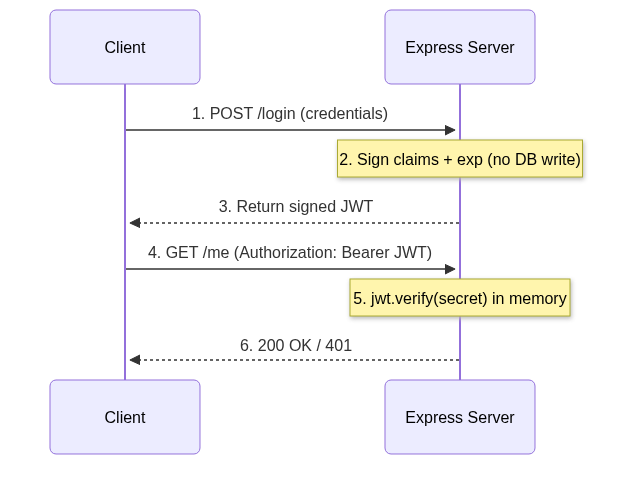
Notice why this is called stateless: the server keeps no list of active tokens. Any valid, unexpired signature is trusted until its exp timestamp passes.
Stateful vs stateless in action (real Express 5.3.0 run)
To see the sharpest real-world difference, I built both flows in one Express 5.3.0 app (Map session store vs jsonwebtoken 9.0.3 HS256 with expiresIn: "15m"), logged in, called /me, logged out, and replayed the exact same credential. This is the full server:
// server.js (Node.js 24.22.1, Express 5.3.0, jsonwebtoken 9.0.3)
const crypto = require("crypto");
const express = require("express");
const jwt = require("jsonwebtoken");

const app = express();
const SECRET = crypto.randomBytes(32).toString("hex"); // new random secret on every start (demo only)
const sessions = new Map(); // in-memory session store: local demo only, use Redis or a database in production

function getSid(req) {
  const match = /(?:^|;\s*)sid=([^;]*)/.exec(req.headers.cookie || "");
  return match ? match[1] : null;
}

// Both logins skip the password check to keep the focus on state (see the JWT post for a real login)
app.post("/session/login", (req, res) => {
  const sid = crypto.randomBytes(16).toString("hex");
  sessions.set(sid, { user: "Asha", role: "member" });
  res.setHeader("Set-Cookie", `sid=${sid}; HttpOnly; SameSite=Lax; Path=/`);
  res.status(200).json({ loggedIn: true, sidLength: sid.length });
});

app.get("/session/me", (req, res) => {
  const session = sessions.get(getSid(req));
  if (!session) return res.status(401).json({ error: "Session expired or logged out" });
  res.status(200).json({ user: session.user, via: "session" });
});

// Session logout deletes the server record:
app.post("/session/logout", (req, res) => {
  const sid = getSid(req);
  if (sid) sessions.delete(sid);
  // Add Secure over HTTPS in production
  res.setHeader("Set-Cookie", "sid=; Max-Age=0; HttpOnly; SameSite=Lax; Path=/");
  res.status(204).send();
});

app.post("/jwt/login", (req, res) => {
  const token = jwt.sign({ sub: "1", user: "Asha", role: "member" }, SECRET, {
    algorithm: "HS256",
    expiresIn: "15m",
  });
  res.status(200).json({ token });
});

// JWT route verifies signature + expiry with no server store:
app.get("/jwt/me", (req, res) => {
  const header = req.headers.authorization || "";
  if (!header.startsWith("Bearer ")) return res.status(401).json({ error: "Missing token" });
  try {
    const claims = jwt.verify(header.slice(7), SECRET, { algorithms: ["HS256"] });
    res.status(200).json({ user: claims.user, via: "jwt" });
  } catch {
    res.status(401).json({ error: "Invalid or expired token" });
  }
});

app.listen(3000, () => console.log("Listening on http://127.0.0.1:3000"));
Run it with node server.js, then run this client in a second terminal. Every line below comes from it:
// client.js: run while server.js is listening
const base = "http://127.0.0.1:3000";

(async () => {
  let res = await fetch(base + "/session/login", { method: "POST" });
  console.log("SESSION login  ->", res.status, await res.text());
  const cookie = res.headers.get("set-cookie").split(";")[0]; // sid=...

  res = await fetch(base + "/session/me", { headers: { cookie } });
  console.log("SESSION /me    ->", res.status, await res.text());

  res = await fetch(base + "/session/logout", { method: "POST", headers: { cookie } });
  console.log("SESSION logout ->", res.status);

  res = await fetch(base + "/session/me", { headers: { cookie } }); // replay the old cookie
  console.log("SESSION replay ->", res.status, await res.text());

  res = await fetch(base + "/jwt/login", { method: "POST" });
  const { token } = await res.json();
  console.log("JWT login      ->", res.status, "tokenLength:", token.length);

  const headers = { Authorization: `Bearer ${token}` };
  res = await fetch(base + "/jwt/me", { headers });
  console.log("JWT /me        ->", res.status, await res.text());

  // There is no JWT logout endpoint: the server keeps no record, so the same token still works
  res = await fetch(base + "/jwt/me", { headers });
  console.log("JWT replay     ->", res.status, await res.text());
})();
Real output from both flows:
SESSION login  -> 200 {"loggedIn":true,"sidLength":32}
SESSION /me    -> 200 {"user":"Asha","via":"session"}
SESSION logout -> 204
SESSION replay -> 401 {"error":"Session expired or logged out"}
JWT login      -> 200 tokenLength: 181
JWT /me        -> 200 {"user":"Asha","via":"jwt"}
JWT replay     -> 200 {"user":"Asha","via":"jwt"}
Two real numbers jump out of that run:
- Instant revocation vs waiting for expiry. Replaying the session cookie after
POST /session/logoutfailed immediately with401. Replaying the same JWT still returned200— there is no server-side logout to call, because a stateless server keeps no record that the user ever logged in. - Credential size. The random session ID was 32 characters; the minimal JWT was 181 characters (nearly 6× larger on every request, and larger still as you add more claims).
Session vs JWT comparison table
| Dimension | Session-based Auth | JWT-based Auth |
|---|---|---|
| Where state lives | Server (Redis / database) | Client (inside the signed token) |
| Server lookup per request | Yes (read session store) | No (verify signature in memory) |
| Instant logout / ban | Built-in (delete session row) | Hard (valid until exp, or add a blocklist) |
| Credential size | Small (e.g., 32-char ID) | Larger (e.g., 181+ chars with claims) |
| Typical transport | HttpOnly Cookie |
Authorization: Bearer header or Cookie |
| Multi-service / mobile APIs | Needs shared session store | Any service with key can verify |
| Scaling trade-off | Must share Redis/DB across instances | Must manage short expiry + refresh tokens |
When to use each (and when NOT to)
Base the choice on your clients and your revocation requirements, not hype:
- Pick Sessions +
HttpOnlyCookies for traditional browser web apps, SaaS dashboards, and e-commerce sites served from one backend (or backends sharing Redis). You get instant logout, instant permission changes, small headers, and automatic browser handling. Do not use in-memoryMapsessions in production — they wipe on every server restart and break across multiple instances; use Redis or your database. - Pick Short-Lived JWTs for mobile apps, third-party APIs, and multi-service architectures where downstream services need to verify identity without calling a central session store on every hop. Do not give JWTs multi-day lifetimes without a revocation strategy, and do not store sensitive secrets in the payload (it is Base64URL-encoded, not encrypted).
- The common hybrid: many production teams issue a short-lived JWT access token (5–15 minutes) paired with a stateful refresh token stored in the database and delivered in an
HttpOnlycookie — giving fast stateless verification on normal API calls while still letting the server revoke refreshes on logout.
Where this leaves you
Cookies are the transport envelope; sessions (stateful) and JWTs (stateless) are the two authentication models. Sessions win on simplicity and instant revocation for browser apps, while short-lived JWTs win when multiple services or mobile clients need self-contained verification.
One honest limit: the demo above used an in-memory Map instead of Redis and skipped OAuth 2.0 / OpenID Connect, CSRF tokens, and refresh-token rotation to stay focused on the core trade-off. For a brand-new full-stack web app today, do you default to cookie sessions or JWTs?
Comments
Join the discussionNo comments yet. Be the first to comment.