Borrow a Method, Lock a this: call(), apply() and bind() Explained
What this means, then how call, apply and bind let you choose it yourself, with a comparison table and real output

Here's an object with a useful method:
const laptop = {
  name: "ThinkPad",
  price: 72000,
  describe(currency, note) {
    return `${this.name} costs ${currency}${this.price} ${note}`;
  },
};

const phone = { name: "Pixel", price: 45000 };
phone needs a describe() too. You could copy the method into it. Or you could borrow laptop's method and run it with phone as its this. That's what call(), apply() and bind() are for. Each one lets you choose this yourself, instead of leaving it to however the function happens to be called.
All outputs below are real, from Node.js 24.22 with "use strict" on, which is how modules and classes behave by default.
this in one minute
this is whoever is calling the function. At the call, look at what's to the left of the dot:
laptop.describe("₹", "(in stock)");
ThinkPad costs ₹72000 (in stock)
laptop is left of the dot, so this is laptop. Take the function away from its object and call it on its own, and there's no caller:
const plain = laptop.describe;
plain("₹", "(?)");
TypeError: Cannot read properties of undefined (reading 'name')
With nothing left of the dot, this is undefined in strict mode, and this.name crashes. I covered every case (global scope, nested objects, arrow functions, event handlers) in Look Left of the Dot: how JavaScript decides what this is. This post is about the next step: choosing this yourself.
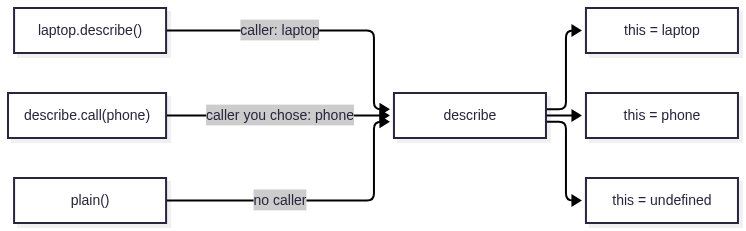
call, apply and bind let you pick the caller yourself.
call(): run it now, with this this
call() runs a function immediately, with the first argument as this. Any further arguments are passed to the function, one by one:
laptop.describe.call(phone, "₹", "(borrowed with call)");
Pixel costs ₹45000 (borrowed with call)
Same function, but this is now phone, so it reads phone.name and phone.price. phone never got a copy of the method. It borrowed it for one call.
apply(): the same, with an array of arguments
apply() does exactly what call() does, with one difference: the function's arguments come as one array.
laptop.describe.apply(phone, ["₹", "(borrowed with apply)"]);
Pixel costs ₹45000 (borrowed with apply)
That's useful when your arguments are already in an array. The classic example is Math.max, which takes separate numbers, not an array:
const scores = [72, 95, 64, 88];
Math.max.apply(null, scores); // 95
Math.max(...scores);          // 95
Both print 95. Math.max doesn't use this, so null is a placeholder. In modern code, the spread operator (...scores) does the same job more readably, which is why you'll see apply less often than you used to. It still shows up in older code and libraries.
bind(): a new function for later
bind() is the odd one out: it doesn't run anything. It returns a new function with this permanently set, which you can store and call later:
const describePhone = laptop.describe.bind(phone);
typeof describePhone;          // "function"
describePhone("₹", "(bound)"); // Pixel costs ₹45000 (bound)
That's exactly what you need when you hand a method to someone else to call later, like a timer. Without bind, the method loses its object:
const counter = {
  count: 0,
  start() {
    setTimeout(this.tick, 0);            // ❌ setTimeout calls it, not counter
    setTimeout(this.tick.bind(this), 0); // ✅ this locked to counter
  },
  tick() { /* logs whether this is counter */ },
};
counter.start();
this is not counter
tick, count = 1
bind can also pre-fill arguments. Pass extra values after this, and they're fixed at the front of every call:
const describeInRupees = laptop.describe.bind(phone, "₹");
describeInRupees("(currency pre-filled)"); // Pixel costs ₹45000 (currency pre-filled)
Two limits worth knowing
A bound function stays bound. Binding it again doesn't change this:
const rebound = describePhone.bind(laptop);
rebound("₹", "(bound again?)");
Pixel costs ₹45000 (bound again?)
Still Pixel. The first bind wins.
Arrow functions ignore all three. An arrow function has no this of its own; it uses the this from where it was written. call, apply and bind can't change that:
const arrowName = () => this.name;
arrowName.call(phone);   // undefined
arrowName.bind(phone)(); // undefined
If you need to choose this, use a regular function or method.
call vs apply vs bind
call() |
apply() |
bind() |
|
|---|---|---|---|
| Runs the function | Immediately | Immediately | No, returns a new function |
Sets this to |
First argument | First argument | First argument, permanently |
| Other arguments | One by one: fn.call(obj, a, b) |
As an array: fn.apply(obj, [a, b]) |
One by one, pre-filled: fn.bind(obj, a) |
| Returns | The function's result | The function's result | A new function |
| Typical use | Borrowing a method once | Arguments already in an array | Callbacks, timers, event handlers |
A memory aid: call is comma-separated, apply is an array, bind is for later.
Try it: the assignment
The brief's four steps in one script:
// 1. An object with a method that uses this
const student = {
  name: "Asha",
  course: "Web Dev Cohort 2026",
  introduce(greeting, city) {
    return `${greeting}! I'm ${this.name} from ${city}, studying ${this.course}.`;
  },
};
console.log(student.introduce("Hi", "Pune"));

// 2. Borrow that method with call()
const mentor = { name: "Ravi", course: "JavaScript" };
console.log(student.introduce.call(mentor, "Hello", "Surat"));

// 3. apply() with array arguments
const args = ["Namaste", "Ahmedabad"];
console.log(student.introduce.apply(mentor, args));

// 4. bind() and store the function
const ravisIntro = student.introduce.bind(mentor, "Hey");
console.log(ravisIntro("Mumbai"));
console.log(ravisIntro("Delhi"));
Hi! I'm Asha from Pune, studying Web Dev Cohort 2026.
Hello! I'm Ravi from Surat, studying JavaScript.
Namaste! I'm Ravi from Ahmedabad, studying JavaScript.
Hey! I'm Ravi from Mumbai, studying JavaScript.
Hey! I'm Ravi from Delhi, studying JavaScript.
One method, written once on student, used by mentor three different ways. The bound version, ravisIntro, remembers both its this and its greeting across calls.
The takeaway: this is normally chosen by whoever calls the function. call and apply let you choose it for one call, and bind lets you choose it for good. This post stuck to plain objects. Classes and new set this their own way, and React class components were a common place to see .bind(this) in constructors.
Which have you used most in real code: bind for callbacks, or the spread operator in place of apply?
Comments
Join the discussionNo comments yet. Be the first to comment.