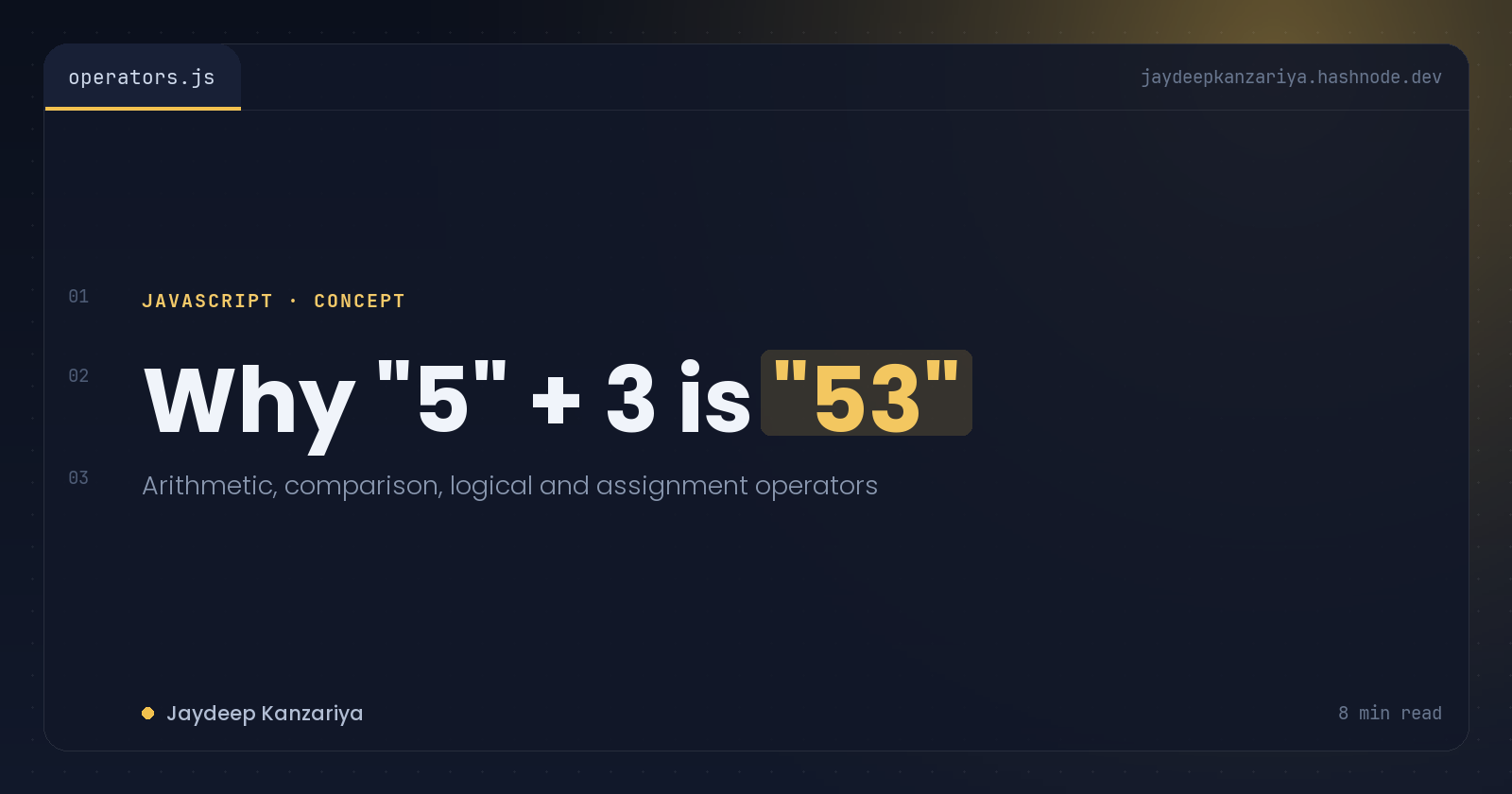
Why \"5\" + 3 Is \"53\": JavaScript Operators for Beginners
Arithmetic, comparison, logical and assignment operators, what each one returns, and the few that don't behave like maths
Open your browser's console and type this:
console.log("5" + 3);
53
Not 8. The string "53". Most JavaScript operators behave exactly like the maths you already know, and a few don't. This post covers the everyday operators (arithmetic, comparison, logical and assignment) and gives the surprising ones the attention they need. Every output below is real, from Node.js 24.22. Your browser console prints the same values.
What an operator is
An operator is a symbol that does something with values. The values it works on are its operands.
2 + 3; // operator: + operands: 2 and 3 result: 5
Every operator produces a result. That's the key thing to watch: what it returns, and what type that is.
| Category | Operators | Example | Returns |
|---|---|---|---|
| Arithmetic | + - * / % |
17 % 5 |
a number (usually) |
| Comparison | == === != !== > < |
5 === "5" |
true or false |
| Logical | && || ! |
age >= 18 && hasTicket |
one of its values |
| Assignment | = += -= |
score += 5 |
stores a new value |
Arithmetic operators: + - * / %
With two numbers, these do what you'd expect:
const a = 17, b = 5;
a + b; // 22
a - b; // 12
a * b; // 85
a / b; // 3.4
a % b; // 2
/ gives decimals. There's no separate "whole number division". And % is the remainder: 17 divided by 5 is 3, with 2 left over. Its everyday job is checking even and odd numbers:
8 % 2; // 0  → even
7 % 2; // 1  → odd
The + surprise
+ has two jobs: adding numbers and joining strings. If either side is a string, it joins:
"5" + 3        "53"
3 + 4 + "px"   "7px"
"px" + 3 + 4   "px34"
It works left to right. 3 + 4 is added first (both numbers), then joined with "px". In the last line, "px" + 3 is already a string, so 4 gets joined too.
The other arithmetic operators only do maths, so they convert strings to numbers instead:
"5" - 3        2
"5" * "2"      10
"abc" * 2      NaN
NaN means "Not a Number": the result of maths that couldn't produce one. This is why values from a form input, which are always strings, need Number(value) before you add them.
Two more you'll meet early:
10 / 0         Infinity
0.1 + 0.2      0.30000000000000004
Dividing by zero doesn't crash; it gives Infinity. And decimals are stored in binary, so some can't be represented exactly. That's true in most programming languages, not just JavaScript. For money, work in whole paise or cents.
Comparison operators: == === != > <
Comparisons always return true or false. > and < behave as expected with numbers. The ones to get right are the equality checks.
== vs ===
=== (strict equality) checks that the value and the type are the same. == (loose equality) first converts the two sides to a common type, then compares. Side by side:
| Comparison | == |
=== |
|---|---|---|
5 and "5" |
true |
false |
0 and false |
true |
false |
"" and 0 |
true |
false |
null and undefined |
true |
false |
== says an empty string equals zero. That's the conversion at work, and it's almost never what you meant. The not-equal versions follow the same pattern: 5 != "5" is false, 5 !== "5" is true.
The rule: use === and !==. If the types might differ, convert on purpose first, Number(input) === 17, so anyone reading the code can see it. (One oddity to know: NaN === NaN is false. To check for it, use Number.isNaN(value).)
Comparing strings
Strings compare character by character, alphabetically:
"apple" < "banana"   true
"10" < "9"           true
"10" > 9             true
"10" < "9" is true because "1" comes before "9". It's comparing text, not numbers. Mix a string with a number ("10" > 9) and the string is converted, so you get the numeric answer. Convert first and you never have to remember which is which.
Logical operators: && || !
Logical operators combine conditions:
&&(AND) is true when both sides are true.||(OR) is true when at least one side is true.!(NOT) flips true to false, and false to true.
| A | B | A && B | A || B | !A |
|---|---|---|---|---|
| true | true | true | true | false |
| true | false | false | true | false |
| false | true | false | true | true |
| false | false | false | false | true |
A real condition:
if (age >= 18 && hasTicket && !isBanned) {
  console.log("Entry allowed");
}
They return values, not just true or false
Here's the part beginners don't expect. && and || return one of their operands, not necessarily a boolean:
"" || "Guest"          "Guest"
"Asha" || "Guest"      "Asha"
null && "never"        null
"Asha" && "Hi Asha"    "Hi Asha"
|| returns the first "truthy" value, or the last one if none are. && returns the first "falsy" value, or the last one if all are truthy. The falsy values are false, 0, "", null, undefined and NaN; everything else is truthy. That's why const name = input || "Guest" is a common way to set a default. They also stop early: in null && "never", the right side isn't evaluated at all.
The catch: 0 || 10 gives 10, because 0 is falsy, even if 0 was a perfectly valid value. The ?? operator only falls back on null or undefined: 0 ?? 10 gives 0. Use ?? when 0 or "" are real answers.
Assignment operators: = += -=
= stores a value in a variable. += and -= are shorthand for "update this variable using its current value":
let score = 10;
score += 5; // same as score = score + 5  → 15
score -= 3; // same as score = score - 3  → 12

let greeting = "Hello";
greeting += ", Asha"; // "Hello, Asha" (+= joins strings too)
The classic bug is using = where you meant ===:
let x = 1;
if (x = 5) {
  console.log("if (x = 5) ran; x is now", x);
}
if (x = 5) ran; x is now 5
x = 5 doesn't compare. It assigns 5 to x, and the result, 5, is truthy, so the if always runs. One = assigns, three === compare.
Try it: the assignment
Here are the three tasks from the cohort brief in one script:
// 1. Arithmetic on two numbers
const a = 17;
const b = 5;
console.log("Sum:", a + b);
console.log("Difference:", a - b);
console.log("Product:", a * b);
console.log("Quotient:", a / b);
console.log("Remainder:", a % b);

// 2. Compare two values with == and ===
const typed = "17"; // what an <input> gives you: always a string
console.log("a == typed:", a == typed);
console.log("a === typed:", a === typed);
console.log("a === Number(typed):", a === Number(typed));

// 3. A small condition with logical operators
const age = 20;
const hasTicket = true;
const isBanned = false;
if (age >= 18 && hasTicket && !isBanned) {
  console.log("Entry allowed");
} else {
  console.log("Entry denied");
}
Sum: 22
Difference: 12
Product: 85
Quotient: 3.4
Remainder: 2
a == typed: true
a === typed: false
a === Number(typed): true
Entry allowed
Look at the middle three lines. == says the number 17 and the string "17" are equal; === says they aren't. Converting with Number() first gives you true and makes the intent obvious.
The takeaway: operators behave like maths until types get mixed. + joins when it sees a string, == converts before comparing, and &&/|| hand back values, not just booleans. Use ===, convert input on purpose, and most surprises go away. This post skipped operator precedence and the less common operators (**, ++, ?.); they follow the same "check what it returns" habit.
Paste [] + [] and [] + {} into your console. Can you explain what + did with each?
Comments
Join the discussionNo comments yet. Be the first to comment.